Thinking

The Exit-Ready Habit

Is your monthly finance review a wasted effort or helping you win?

When I asked Jonathan Baker (M&A expert) to distill agency exit preparedness (a good proxy for a healthy firm in general) down to a single habit, he pointed to the monthly finance review and shared some sound advice.

It’s great to have a habit of reviewing your key metrics and reporting with your leaders. But is your review effective?

  1. Who do you invite?
  2. What is the purpose and what do you cover?
  3. What preparation do you expect of participants?

If your review consists of your CFO, FD, or accountant taking the team through your monthly financial statements, you’re missing most of the value.

Here’s how to maximize the value of your monthly review:

  1. Purpose – Expose reality, align on actions, and keep accountable
  2. Attendees – Everyone who can significantly influence the numbers (and generally no one else)
  3. Scope – All your most important business metrics (not just financial; leading and lagging), with enough detail to see what is driving the numbers
  4. Preparation – Complete and share reporting ahead of time; each person then prepares plans to share for addressing issues and opportunities in their areas of the firm and questions for other participants

The result? A meeting that helps you face your reality together, move quickly to action, and create a culture of ownership, accountability, and teamwork.

You can find the full conversation with Jonathan on exit preparedness here.

Better problem-solving

Are you happy with how well and quickly you’re solving the biggest problems in your firm?

In the agency world, we’re usually spread thin and moving fast. Lists get longer and staying across everything is hard. We can lose even more ground when we put a lot of effort into something without success.

If solving a problem matters and there isn’t a straightforward, easy fix, slow down to think things through. Your future self will thank you. (Ask me how I know!)

On the surface, solving problems is simple enough:

  1. Expose reality
  2. Act on it
  3. Repeat

But like building a car, creating a vehicle to solve a problem in your firm usually takes many parts working well together. The ignition needs a starter, the starter a battery, and the battery an alternator.

If you’re not getting results (or want to increase the odds you do), return to first principles to find any missing links.

  1. Problem – Understand what’s wrong and why it matters
  2. Metrics – Know how to measure the problem
  3. Aim – Define what success is
  4. Drivers – Diagnose contributors and causes
  5. Levers – Find sources of leverage
  6. Priorities – Choose levers considering impact and effort
  7. Action – Deploy the right people and resources

Let’s apply this to an example:

  1. Problem – Delivery/services profit margin has declined 20% YoY
  2. Metrics – Delivery margin and also utilization, % billable, EHR, CPH
  3. Aim – Increase delivery margin 20%
  4. Drivers – Measurement reveals the following:
    1. Decrease in client hours
    2. Only a minor decrease in capacity
    3. Increase in cost per hour
    4. Decrease in % billable
    5. Only a minor increase in effective hourly rate
  5. Levers – Segmenting and analysis reveal:
    1. Clients with more opportunities to add value and increase hours
    2. Staff that are persistently underutilized
    3. Clients being over-served and under-billed
    4. Clients overdue for rate increases
    5. One team with a pattern of client demands for invoice credits
  6. Priorities – Weighing impact and effort, our analysis shows the most leverage will come from:
    1. Rate increases for select clients (above average hours, below average rates)
    2. Account review and strategy for select clients (more opportunities)
    3. Ending engagements with select staff whose skills and interests no longer align with our client portfolio
  7. Action – Each of these priorities is assigned a single accountable owner with the time, capabilities, and empowerment to succeed

The whole problem-solving effort is at risk if any of these pieces are missing at the start. And as you take action, revisit first principles periodically to close any gaps that develop.

To fix our problem-solving itself, we slow down and:

  1. Expose reality
  2. Act on it
  3. Repeat

Application: Think of a problem you don’t have traction solving or one you’re about to start solving. Set aside a few minutes to work through first principles and find any gaps; then make space to close them.

Making wise investments in your firm

Is this a good investment for your agency?

You’re faced with a problem in your agency:

  • You need more leads
  • You need more capacity
  • You need more visibility
  • You need less client churn

Before we evaluate solutions, let’s remember that some problems aren’t worth solving (yet). There are more valuable places to invest time and money.

If this problem deserves attention now, let’s look at a few ways to evaluate solutions, and then unpack a few examples:

Fit-to-purpose: ask the questions to get beyond symptoms and pinpoint the exact problem you want to solve. Then take a critical look at the options you’re considering to see if they match up. Also, have you done the due diligence to discover the best available solutions?

Investment shape: on a timeline, compare each option’s investment (time and money) required, expected return/value, and risk level.

Opportunity cost: consider other ways to invest the time and money you could spend solving this problem. How might the return compare?

Now, let’s take a look at a few examples using some of the evaluation approaches above:

  1. Increased delivery capacity: you have more quality, sustainable demand than you can fulfill. So, you decide to hire another senior developer. You expect to bill $300k/year and budget $150k/year in total cost (salary, benefits, paid leave, tools/training, etc). With a 25% operating cost in the firm, you’re spending roughly $3 to earn $4. Typically, we are quite pleased with a return like this. It’s not risk-free (a hire could not work out well or client work may decrease), but if done with care, the risk is modest.
  2. Increased marketing reach: you want to increase your qualified leads, so you decide to invest 1% of AGI (gross income) in a new marketing channel. If this investment increases your AGI 10%, and you have a 25% operating margin, you’re spending $1 to earn $2.50. However, an investment in a new channel may carry a lot of risk; it may have a long delay in returns or no returns.
  3. Increased delivery margin: you want to improve your delivery profit, so you invest in people, software, consulting, or training. For every $1 spent, how much additional operating profit is a good return? And how does risk factor in? You’d want very low risk if you spend $1 to get $1.25. But spending $1 to get $5, even with more risk, may be reasonable.
  4. Passive investments: if you don’t see any great ways to invest your operating profit back in the firm, you might put the money in an index fund and get a 7% annual return. In this case, you’re essentially spending $1 to earn $1.07. There is still some risk, but if you buy and hold, that risk is likely limited; your capital is just tied up.

We can save ourselves a lot of money, time, and disappointment with a careful look at:

  • Fit-to-purpose
  • The expected timeline of investment, return, and risk
  • Opportunity cost

Our investment capital is not unlimited, and it’s the fuel for our future. Let’s use it wisely.

Ask the big questions

Are you asking yourself the right questions?

Sarah Durham and I recently had a great conversation about her experience building an agency, buying an agency, selling both, and life after the exits.

One thing that quickly became clear to me: Sarah has asked herself some really helpful questions over the years and her reflection has shaped a life with few regrets.

It makes me stop and consider:

  • Am I asking myself the right questions and taking the time to reflect deeply on them?
  • Am I asking my clients the right questions and helping them reflect well?

On the theme of our current podcast series, beginning with the end in mind, these questions are valuable:

1. What if someone offered you acquisition terms today that were too good to pass up: what would you do after the exit? Who would you be and why?

2. What if you knew you were locked into running your agency until retirement age, no choice: how would that change your decisions and priorities now?

Setting a goal on the distant horizon may motivate some of us, but the journey (and company) almost always matter more than the destination.

Take time to reflect – on the past, present, and future.

Then act to make today meaningful and fruitful and tomorrow even better.

Sarah now serves as an advisor and ICF-credentialed coach to agency owners and leaders, helping them hold space for the important, living and leading more intentionally.

Listen to the episode to hear more of Sarah's great questions, her story, Big Duck’s transition to a worker-owned cooperative, and life after the exit.

Finding your revenue leaks

While you paddle ahead on your top priorities for 2025, take time to check the boat for leaks slowing you down.

One place to look is your firm’s revenue journey.

We cheer when we sign a new engagement, but if the revenue doesn’t make it to our bank account, we’re in trouble.

You could start all the way at the top of your marketing funnel, but for today, let’s begin from where a scope of work gets approved. Revenue then (we hope) gets:

  1. Booked
  2. Earned
  3. Invoiced
  4. Paid

Does this sound pretty elementary? You might be surprised at how much room there is for unnoticed leakage from booked to paid.

Let’s take a quick scenario. Imagine a firm with 45% delivery cost and 25% operating cost. With just minor issues, their leakage could look like this:

  1. Earned: 98% of booked
  2. Invoiced: 97% of earned
  3. Paid: 96% of invoiced

Just a 1% reduction in leakage at each stage will mean a 10% increase in operating profit. Yes!

So how can you surface your best paths to capturing more profit here?

  1. Calculate your total revenue at each stage from each of the past 6 months (and total)
  2. Calculate the leakage at each stage per month (and total)
  3. Identify the transition with the biggest leakage (booked>earned, earned>invoiced, invoiced>paid), looking at the trend as well
  4. Drill down to your engagement or invoice reporting for that transition to understand what is happening and why
  5. Identify any patterns in the what and why – clients, types of engagements, teams, circumstances – and explore possible causes

Issues you uncover could relate to discovery and planning, team scheduling, managing client expectations and scope changes, communication between PMs and Finance, collections, and more. Every stage of the client journey presents risks and opportunities for the revenue journey.

Remember to prioritize your exploration based on what will make the biggest impact on profit with the least effort.

Then:

  1. Pursue the highest-value cases of uncaptured revenue
  2. Fix the highest-value causes of leakage patterns

The result? More profit!

That extra profit can be invested in your capabilities to create value for your clients, your team, and yourself, and even more profit follows.

One more thing: today I published my great chat with Shaun Tyndall on the Agency Health Podcast. He shared the details of his approach to building long-term client relationships, finding freedom from the feast-or-famine cycle, and structuring win-win retainers. Take a listen.

Systems over goals

2025 begins! What future do you want to build for yourself over the next 52 weeks?

As a kid, I famously said, “Whenever I even think about doing the dishes, I feel so tired.” Before I turned 18, I did the dishes, made dinner (not the boxed kind), vacuumed and mopped, and cleaned the bathroom (among other things) countless times.

Now, at 39, I feel incredibly grateful I had those opportunities (and parents who loved me enough to nurture my capabilities). As an adult, none of those tasks require much mental or emotional effort. Leaving energy for more valuable things.

Laura and I have three kids of our own now, and we're helping them do the same. The strategy? Give them one new responsibility at a time, ideally one that needs doing at least 5 times/week. Things like unloading the dishwasher, clearing and wiping the table, and making breakfast or dinner (from scratch). Supply patient guidance and accountability. Over time, they master it. Success becomes (more) automatic through many repetitions.

Success in life and business is not too different.

Less about setting goals and creating action plans. More about choosing a few priorities and repeated actions to make progress.

Less about chasing what we love to do. More about coming to enjoy and appreciate what we do well, what is helping us make progress.

As this year begins, I'm pushing ahead with my repeated actions, my systems:

  1. Daily planning with Akiflow
  2. Weekly demos and planning time with my business partner and clients
  3. Weekly writing time for this newsletter and LinkedIn
  4. Bi-weekly release of a podcast episode
  5. Daily walking 5+ miles at my desk
  6. Monthly pursuing a new set of conversations to grow relationships with partners and clients.

All of this helps me Building increasingly effective, repeatable ways to create value for others and capture value as well.

Ask yourself:

  1. Where do you want to be at the end of 2025? Begin with the end in mind.
  2. What do you need to prioritize to help you get there?
  3. What repeated actions will help you make the most progress?

Then set yourself up to succeed at doing those things. Start small. Be steady yet patient with yourself. Build momentum and mastery. Your actions become habits, and your habits stack into systems. Your growth in both capability and progress may surprise you.

If you like a good nonfiction read, Atomic Habits and Make Time are great titles to fuel your success this year with a focus on systems over goals.

And one more thing ... the first episode of our 4-part "Begin with the End in Mind" mini-series dropped today, a conversation with Jonathan Baker, M&A practice lead at Punctuation, with some great insights, including the #1 habit to help you build towards a great exit from your firm. You can find it on the Agency Health Podcast website and your favorite podcast platforms.

Wishing you a meaningful and rewarding 2025!

Getting traction

How do you escape the agency treadmill and get to your prize?

A stick man running on the "agency life" treadmill, trying to reach the "prize" but never getting there.

As you wrap up 2024, maybe you haven’t made all the progress you hoped for in January.

For many of us, what makes agency life meaningful is the variety of new problems to solve. But this is the same thing that can turn agency life into an endless treadmill.

New types of clients and engagements. New approaches. Figuring it out as we go, with everyone doing whatever it takes to deliver.

Leadership can be so busy supporting the team and firefighting that there’s little headspace to address underlying issues and make things better.

There is a way to beat the treadmill. A path to more freedom. More impact for clients. More profit. More options.

The key is deliberate action: expose reality and act on it.

It’s not sexy or innovative. But it works.

Make space with your leaders to answer these questions:

  1. Where do we want to be at the end of 2025? Describe this place, how it’s different from where you are now, how you’d know you arrived.
  2. How will we measure success? Choose your key metrics and draft the targets for each to make your December 2025 destination tangible.
  3. Where are we now? Measure the current state of your key metrics. Filter the dataset to understand what subsets drive the average up and down.
  4. What is the first stage? Set an initial objective for each metric between the current state and your end-of-year targets. Inspired by your understanding of the drivers, identify the levers and approaches you’ll use to make progress. Set a date for the first stage.
  5. Who will champion what? Decide who will own each metric+objective. And make sure everyone has the clarity, capabilities, and support to succeed.
  6. How will we remain accountable? Schedule a rhythm of check-ins (at least monthly) to keep exposing reality, hold each other accountable, and troubleshoot challenges.

With a clear view of where you’re going and an empowered and accountable team, you will accelerate toward your goals. And shortcomings in your leadership and team will surface so you can address them and keep moving forward.

Reality is not always comfortable. Facing it can be painful and taxing. But as you do, you’ll get traction and build momentum.

It’s worth the effort.

Who improves profit?

In the last post, we talked about EHR (effective hourly rate) and how to use it to find the levers to achieve a 20% increase in operating profit (that’s the profit from 2.4 additional months of work per year, without the work).

That all sounds lovely. We smile and nod our heads. But few agencies will do the work to capture that profit.

Why?

Because even though it may be simple, it’s not easy. It takes focused, deliberate effort, something most agency leaders don’t have to spare.

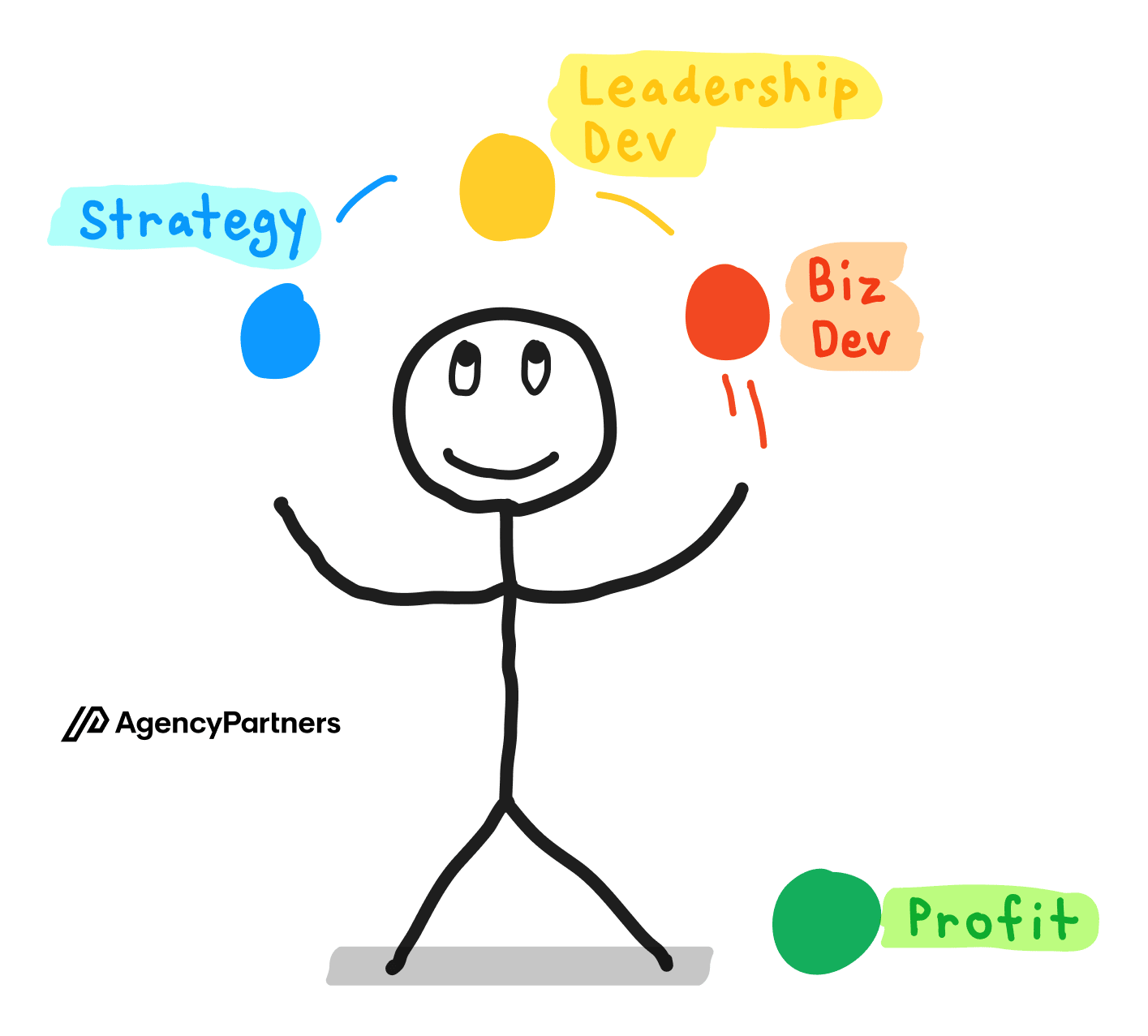
Your best ways to add value as an agency owner are:

  1. Overall Strategy
  2. Leadership Development
  3. Revenue Development

Someone else needs to be responsible for improving profitability. It's valuable yet delegatable. It must be someone who:

  • Knows agency economics and operations end-to-end
  • Works well with everyone to create buy-in, coordinate action, and get results
  • Has the headspace, incentive, and empowerment to be effective

Consider carefully: do you have someone to champion profitability who checks all those boxes?

In most agencies, improving profitability will never be a full-time role. Without the right champion, it gets crowded out by other work.

This is where you come in: to see the problem (and opportunity) and ensure the right person is set up well to maximize profit. A lot is at stake.

Effective Hourly Rate

Why is Effective Hourly Rate (EHR) one of my favorite agency metrics?

Because it helps expose some of the fastest ways to grow profit. Here’s how …

Definition: Effective Hourly Rate (also called Average Billable Rate) = (Earned Revenue - Credits - Write-Offs) / Total Client Hours

EHR tells us what we’re actually earning per hour, factoring in the client hours we won’t be paid for (because of engagement overhead and poor value delivery, expectations management, or client fit).

EHR has clear drivers and levers we can expose and act on.

To see the drivers, first compute your agency-wide average:

  1. Hourly charge rate
  2. Billable % of client hours
  3. % of earned revenue credited and written off

Then compare those agency-wide averages to the numbers for:

  1. Your top 5 clients (by volume of hours)
  2. Each service offering and client type
  3. Each delivery division or practice area

The outliers will show you what is pushing the average positive or negative. (Check the trends too.)

And then the levers emerge:

  1. Clients that need a rate increase or that merit more care (and replication)
  2. Service offerings (and client types) to fix/fire or scale
  3. Divisions/practice areas that need help or merit scaling

Keep focused, and this won’t become overwhelming:

  1. Sort the opportunities by estimated financial value
  2. Assign a champion for each of the top 2 opportunities to uncover what’s happening and the likely causes, then suggest actions to take (with input from the frontline team)

Once you've done this, you can often asses an area in 30-60 minutes. Improvements will take more effort, but the return can be excellent because you’ll only act on opportunities with very positive impact vs. effort.

Let’s take a quick look at the numbers in an example agency to see how valuable this can be.

  • 55% delivery margin and 20% operating margin
  • 2500 client hours per month
  • 88% of client hours are billable
  • Average hourly charge rate of $175

This means we’d earn $385,000 in revenue per month with an EHR of $154.

Now let’s pull a few levers we surfaced to:

  1. Raise our billability by 2% (utilization unchanged)
  2. Raise the average charge rate by 2%

The magic of math means we raise operating profit by 20%, an additional $200,000 per year! That’s the profit from 2.4 extra months of work, without the work. Small changes, big impact!

EHR is the star of the show here. You can do whatever requires less effort to improve it — raising billability and/or charge rates — the effect on profit is the same. (We’ll leave credits and write-offs for another time.)

Don’t miss out on great opportunities to grow profit. It’s the oxygen of your firm.

Think (more)

If someone asked me to give them my very best advice – only one thing – I know what I’d say. It's simple, but doesn't get enough attention.

Just doing can be like trying to move a large boulder with your hands. Thinking well adds a lever and fulcrum.

First, consider this: how many times have you driven somewhere you didn’t intend to go? For me, quite a few. I may find myself at the grocery store instead of the post office. I wasn’t conscious of where I was driving, so my subconscious drove wherever was familiar and easy.

That is what happens when we live on autopilot. We keep moving. We go somewhere. But mental autopilot won’t take us to new and hard-to-reach places.

Conscious, creative, critical thinking is our greatest ability as humans. It can help us achieve more than we imagine.

Think.
Think well.
Think more and more often.

Good thinking = better actions and better outcomes.

You’ll never be and do what you could if you don’t make time to think well. Don’t leave thinking to chance.

For your business and professional life, start your thinking here:

  1. Where you’re going
  2. Why it matters
  3. What you’re doing to get there
  4. How to do it better

When? As often as helpful. At least once a day.

How much? Very likely more than you are now. At least a few minutes every day. And more time periodically: every few days, weeks, months, quarters, and years.

With whom? Yourself, of course. But also – a little less frequently – with your team.

And how? Find the ways that work well for you. Thinking can look like:

  1. A walk, hike, or bike ride
  2. Journaling/writing – on paper or with a keyboard
  3. An open-minded discussion
  4. Putting your feet up on your desk

However you do it, summarize your thoughts in a journal, video, or voice memo.

A few more tips:

  • Keep a list of questions or topics for your thinking times. Add to it any time you encounter something worth reflecting on.
  • Be spontaneous. When you’re feeling stuck or making a decision, open the journal, take a little walk, or have a short phone call with a thinking partner.
  • Experiment with new approaches, times, and environments.
  • Don’t confuse this kind of thinking with planning. Good thinking precedes good planning.

What is the first step? Schedule two thinking times:

  1. Daily for 5-10 minutes
  2. Weekly for 30-60 minutes

That’s just 1% of your time per week.

And no amount of great advice is of any use unless you think it through and consider how to apply it.

Thinking well is the foundation of doing well.

Three ways to protect your firm

Picture yourself walking around NYC at night with noise-canceling headphones and your eyes fixed on your feet. Would you feel safe? Probably not.

Situational awareness is your friend: so you don’t get mugged, hit by a car, or find yourself nowhere near your destination.

It’s the same for a business. Good situational awareness can spare you a lot of trouble.

For an agency, the first three threat areas to watch are:

  • Cash runway
  • Client credit
  • Client concentration

Cash runway

What if you had cash in the bank to cover 10 years of operating expenses? As long as you didn’t go on a spending spree, face embezzlement, or ruin your reputation, you’d be invincible.

Having plenty of cash runway gives you the breathing room to make the best decisions for your business.

  • Turning away poor-fit prospects
  • Firing bad clients
  • Investing steadily in marketing & sales
  • Standing firm on appropriate pricing
  • Taking good care of your people
  • Investing in your expertise and processes

A healthy cash runway gives you the confidence to take some risks, to try new things. It helps you maximize the value you create for your clients, your team, and yourself.

Here’s what you need to do:

  1. Set your cash runway target
  2. Compare your cash runway to your target every month
  3. If there’s a gap or negative trend, identify the cause, and fix it

If your agency is healthy (generating > 15% operating profit steadily, with a strong pipeline and no other notable risks), then 2 months of operating expenses may be safe. In general, aim for 3 months. And if you have any notable risks (an ugly pipeline, a client concentration issue, etc), aim for more.

(Note: These funds don’t need to sit in your business checking account; you want most of them earning good interest for you, but still liquid and accessible.)

If you’re already watching and improving your cash runway, give yourself a pat on the back! If you aren’t yet, take a few minutes to reflect: why aren’t you?

Client credit

Are you accidentally bankrolling your clients?

Since most clients pay their bills pretty well, we can be lulled into a false sense of security.

Stop and consider though: one larger client getting behind on payments could put you in a serious cash crunch – and could tank your profitability as well if they never pay.

I’ve seen this happen multiple times: a good client who has been a steady payer starts paying slower and then, in the end, never pays off their remaining balance.

The more frequent case is many clients each owing you a bit more than they should. Your bank balance could be higher – instead of theirs!

Build your credit management approach on these 3 practices:

1. Set a credit limit for each client:

  • Make sure the caps are an amount that you’re OK losing entirely, worst case. I’d recommend a default limit that is less than 2 weeks of agency operating expenses per client.
  • Require a rigorous process to increase a client’s cap (with a built-in expiration date, forcing a fresh review).
  • Have a mandatory stop-work policy when a client’s cap is exceeded (no teeth = no use). And of course, give them a heads up in plenty of time.
  • Tell clients about your policy and include it in your agreements.
  • As you start, for anyone above their cap give them 30 days to get in good standing or agree on a payment plan with frequent installments to get below their credit limit within 90 days.

2. Have a credit check for all new clients:

  • Talk to 3 credit references (e.g. their banker and 2 vendors).
  • Pull a credit report on their business.
  • If a potential client is a credit risk, simply require advance payment. This can be done with frequent payments via bank draft to limit their exposure too.

3. Institute a process to review the credit of all accounts monthly alongside a general review of accounts receivable.

  • Have a standard set of communications ready (step by step) for any clients over or at risk of going over their credit limit to make this easy and efficient.
  • Feel free to use good cop / bad cop by having your COO or CFO be the escalation point communicating with clients just before stopping work.

A few hours of effort could save you hundreds of thousands in unpaid receivables and a lot of sleep loss.

Client concentration

As agencies, we’re always looking for great new clients who want to do a lot of work with us. But what if a client does want to do a LOT of work with us?

This is often what can happen:

  1. We accept a gorilla client at reduced rates (“we’ll make it up in volume”)
  2. We hire to meet the gorilla client’s needs (“we need help”)
  3. We slow down marketing and sales (“we’re busy”)

In short, we create the potential for a lot of pain in the future.

Let’s look at how we can decrease the risks and increase the rewards of gorilla clients.

First, face your client concentration risks. Calculate the percentage of your revenue from each of your top 5 clients (looking back and ahead).

You have a notable threat if over 20% of your revenue comes from one client and another layer of risk if more than 40% of your revenue comes from your top 3 clients.

Next, assess your level of risk in a worst-case scenario. How would it affect your agency if your largest client left overnight? Decide what an acceptable level of client concentration is, just like with client credit limits.

Once you understand your risk, take appropriate action:

  • Only accept gorilla clients with above-average margins.
  • Maintain a longer cash runway, so you are still OK if a large client leaves.
  • Invest a good share of the additional profit in building your sales pipeline. If you want to grow, focus on landing more clients like today’s gorillas until what was a gorilla becomes typical.
  • If you aren’t prepared to grow, spread the work over more time, creating more security instead of less. Or partner with another agency (or freelancers) to complete the work together, retaining your share of the profits.

We’ve covered three of the most immediate threats to agencies:

  1. Insufficient cash runway
  2. Client credit issues
  3. Client concentration issues

A little effort now in each of these areas can spare you a great deal of stress and loss in the future.